Campaigns
At Child Autism UK, we believe every child deserves access to effective support and education.

Child Autism UK often contributes to campaigns that support autistic children and their families.
This includes working with other like-minded organisations to lobby local authorities and the Government to ensure that autistic children and parents have a voice.
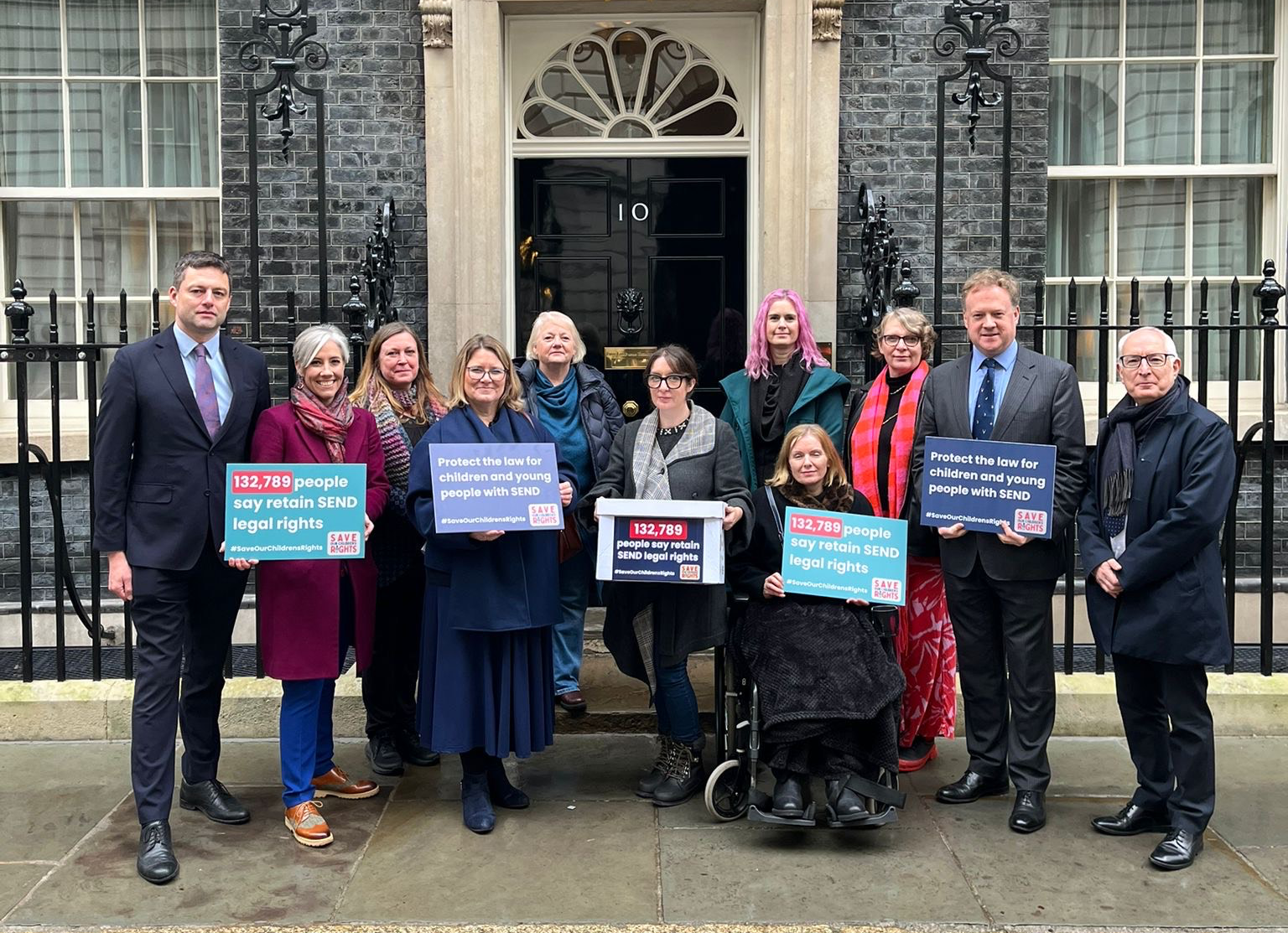
Child Autism UK supports the #SaveOurChildrensRights campaign, which calls on the Government to abandon any plans that weaken SEND’s legal framework and put children and young people’s futures at risk.
Child Autism UK Response to the Government’s Schools White Paper and SEND Reform Proposals
This is Child Autism UK’s initial response to the Government’s proposed SEND reforms, published on 23 February 2026 as part of the Schools White Paper, Every Child Achieving and Thriving.
Changes to EHCPs – a reduction in legal rights, despite claims to the contrary
The Government argues the proposals represent a ‘radical expansion in rights.’ However, these are not reflected in the proposed reforms.
We entirely oppose the removal or reduction of any legal rights for children with special educational needs.
Our concerns include:
-
- EHCPs would be significantly more difficult to access. The Government plans will reduce the number of children eligible for EHCPs. What is now “SEN Support” will be replaced by an Individual Support Plan (ISP), a digital record of the child’s needs and their day-to-day support at school. However, unlike EHCPs, the Government has not explained how parents can hold the effectiveness of ISPs to account.
-
- EHCPs will be restricted to children with ‘complex needs’ without any definition as to what “complex” means. Under the proposed new system, EHCPs would be built around “Specialist Provision Packages”. These would be defined by the Government based on seven broad categories rather than a child’s specific needs, as EHCPs are now.
Examples given in the white paper – such as physical disability requiring personal care assistance, or severe learning disability – suggest a narrow definition rooted in medical and physical disability. This framing excludes most autistic children, whose needs are no less complex or significant for being less visible.
An EHCP’s value is its ability to specify support that is individual, quantified and legally enforceable. If the system moves toward standardised categories and packages, there is a serious risk that services will be limited to what is locally available or affordable – rather than what a child needs to access education safely and consistently.
- EHCPs will be restricted to children with ‘complex needs’ without any definition as to what “complex” means. Under the proposed new system, EHCPs would be built around “Specialist Provision Packages”. These would be defined by the Government based on seven broad categories rather than a child’s specific needs, as EHCPs are now.
-
- Autistic children are among those most at risk. Many have overlapping needs, including differences in processing information, communication, and coping with anxiety. A child may be confident in one area but struggle significantly in others — which can make accessing education extremely challenging.
There is no single, neat measure by which autistic children can be assessed, and the Government must not attempt to impose one. Tailored, legally protected services cannot be replaced with generic “off the shelf” programmes that have no basis in evidence.
- Autistic children are among those most at risk. Many have overlapping needs, including differences in processing information, communication, and coping with anxiety. A child may be confident in one area but struggle significantly in others — which can make accessing education extremely challenging.
-
- Many children will lose their provision when transitioning to secondary education. Under the new system, children will be reassessed when moving to secondary school. Despite the Government’s assurances, the narrower eligibility criteria mean that many children could lose not just their EHCP, but also their current school placement and the level of support they receive — either at a transition review or a subsequent annual review.
Children attending special primary schools could be forced into a busy, unsuitable mainstream setting. It is also unclear how these reassessments would apply to children in all-through special schools or middle schools, leaving yet more families facing uncertainty.
- Many children will lose their provision when transitioning to secondary education. Under the new system, children will be reassessed when moving to secondary school. Despite the Government’s assurances, the narrower eligibility criteria mean that many children could lose not just their EHCP, but also their current school placement and the level of support they receive — either at a transition review or a subsequent annual review.
- EHCP Tribunals will have limited powers to direct local authorities to name an appropriate school. Instead, the LA will be told to “reconsider” the placement. This risks families being trapped in a delay loop – where their child remains out of school or struggling through an unsuitable placement. It would also reduce meaningful parental choice at a point when the system is already failing their child.
Although the White Paper states that EHCP reforms will not begin until 2029, we are also concerned that reviews conducted in the meantime will be influenced by the proposed changes. That means parents will have to fight even harder to retain their child’s plan.
Many autistic children already attending mainstream are only able to thrive thanks to the essential, tailored support EHCPs provide. But it is naïve to think that cash-strapped LAs won’t use school transitions to challenge them.
The drive for mainstream inclusion is underfunded and understaffed
We support the principle that, where appropriate, children should be educated in their local mainstream school alongside their peers. However, the proposals push mainstream schooling as the default for all. This is unrealistic at best and harmful at worst.
The proposals to increase accessibility and training in mainstream schools are welcome in principle. But the funding attached is wholly inadequate.
£1.6 billion over three years through a new Inclusive Mainstream Fund sounds significant. But in reality it only amounts to a few thousand pounds per school per year. This isn’t enough to fund even a single additional teaching assistant in most primary schools.
The Government says it will also provide £200 million training programme. It’s not clear how this will be spent, but teachers cannot cover the full spectrum of SEND needs. A few days’ training is no substitute for specialist expertise or personalised support. Additionally, training cannot make up for a shortage of class teachers, specialist teachers, or teaching assistants.
Practicalities have been ignored in favour of ideology. The sheer number of children with SEND, who have a wide range of different and sometimes conflicting needs, cannot be adequately supported within a mainstream classroom. Schools will be overwhelmed.
To make inclusion work, schools would need much smaller class sizes, adapted environments, significant input from specialist therapists, and far more teaching assistants than the proposals fund. The proposals are designed to meet budget quotas, not children’s needs.
Indeed, as these reforms stand, we can envisage an exodus from the teaching profession. Staff will be faced with an increased number of children with SEND needs, while also losing much of the support they currently receive.
Saving money, not supporting children
We believe the driving force behind these proposals is cost reduction, not the effective education of children with SEND.
The Government has been explicit that the current system is ‘financially unsustainable.’ We do not dispute the financial pressures, but we profoundly disagree with the solution of reducing children’s legal rights and entitlements to contain costs.
The Government should not remove legal protections based on an untested model. It is perfectly possible to add in all the additional support measures to mainstream to demonstrate that this works, while leaving the law intact. If these principles work, the need for EHCP requests will reduce naturally over time. This is the ethical and sensible way to proceed.
The irony is that if these reforms are introduced as proposed, they will ultimately cost the economy far more.
- Parents will be forced to give up work to support children who are no longer adequately provided for and who fall out of the school system.
- Mental health needs will increase.
- Fewer children will reach their potential, leading to greater dependency and higher long-term care and support costs.
- Local authorities who do have a legal duty to provide an education will either shoehorn a child into one of the seven categories to find them a specialist school or have to fund education outside of school.
- Many autistic young people, who may have had the potential to live independently and contribute to the economy, will no longer be able to do so.
- As Measure What Matters data shows, autistic children whose needs are not met can end up in a life-threatening condition.
Our call to the Government
Current legal rights – including access to EHCPs – must be retained.
We urge the Government to listen urgently to those most impacted by the changes. Stop the ideological rhetoric. Look at the evidence and listen to the voices of families and young people—both those who are autistic and those who teach them and support them.
These proposals will cause real and lasting harm to some of the most vulnerable children in our society.
We will be responding fully to the consultation and will continue to advocate fiercely for the rights of autistic children and their families.